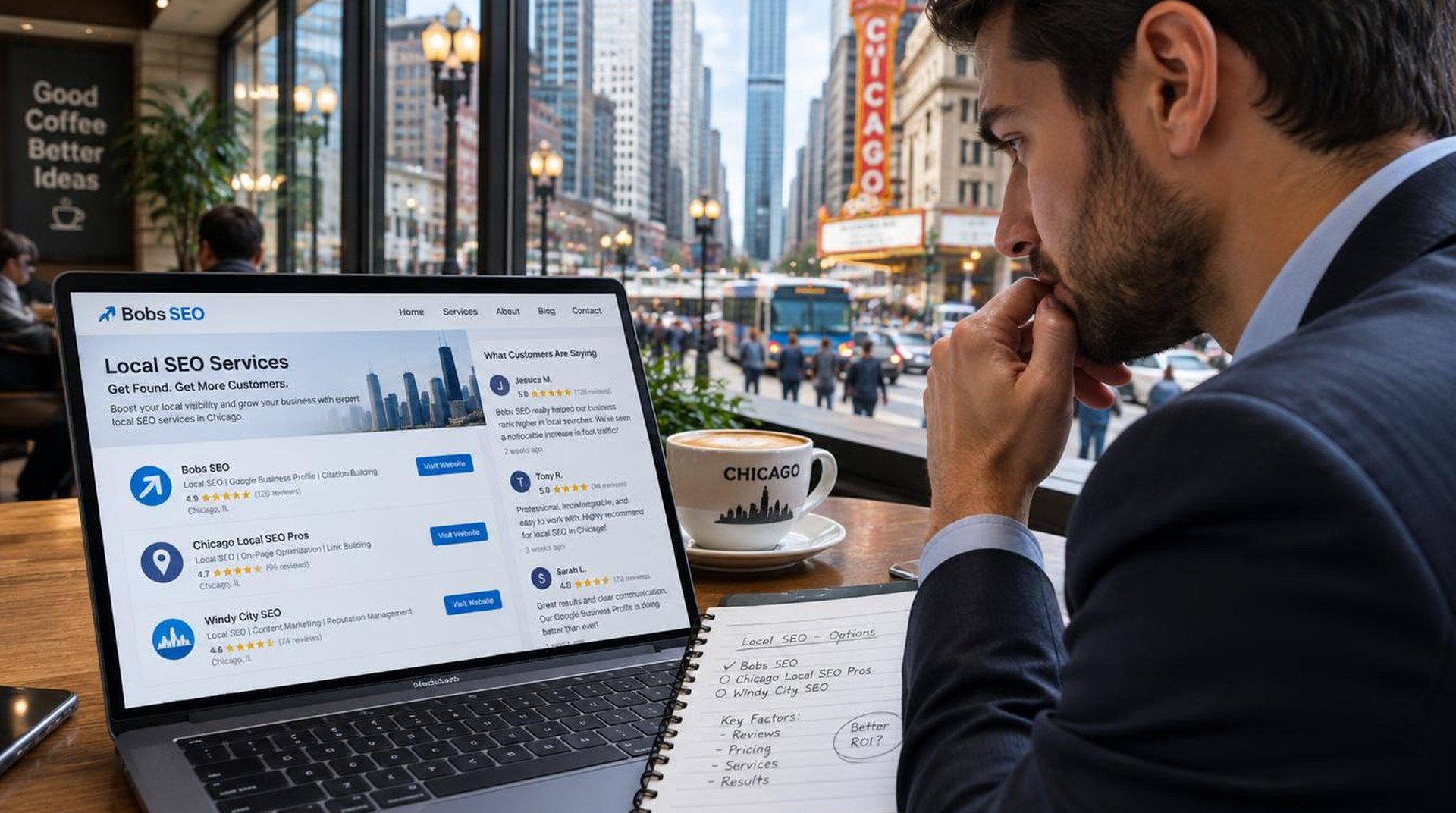
Why local visibility matters in Chicago’s competitive market
A business serving the West Loop competes in a different local context from one targeting finance customers in the Loop. Chicago SEO needs to reflect that difference: businesses compete across distinct areas, industries, and customer needs, not just for one citywide search.
The Loop, River North, Fulton Market, the Magnificent Mile, Wicker Park, Lincoln Park, and the West Loop each have their own mix of businesses and audiences. A nearby shop may need to show why it suits someone ready to visit, while a professional service serving clients across the city may need to explain its expertise and reach.
Chicago’s business sectors include finance, healthcare, manufacturing, logistics, legal services, real estate, hospitality, retail, technology, education, and professional services. The competition and customer intent differ within and across those fields. A useful page speaks to a specific need, rather than treating every searcher as the same customer.
| Chicago area or sector | Example audience intent | Useful landing-page angle |
|---|---|---|
| The Loop and finance | Comparing financial services | Explain service options and who each serves |
| River North and technology | Evaluating a local technology provider | Describe the provider’s services and support |
| Fulton Market and West Loop | Finding B2B or professional services | Clarify business needs served and service area |
| Wicker Park and Lincoln Park | Choosing nearby retail or hospitality | Show what customers can find or experience nearby |
These are illustrative content angles, not claims about search volume. They show why visibility should be shaped around your actual audience and offer. A business with a neighborhood storefront may need a different message from a firm whose clients come from several parts of the city.
Generic citywide language can leave a user unsure whether you serve their area or solve their problem. Make the page’s audience and purpose clear, then build a search strategy around what your business can genuinely deliver. The local market context points to the choices a focused strategy should prioritize.
What should a Chicago SEO Marketing strategy prioritize?
Start by matching one important customer need to one useful page, rather than trying to rank for every possible term at once. A Chicago SEO marketing strategy works best when each step connects the business, the search, and the page that can answer it.
If you are asking, “How to SEO for beginners?”, begin with a clear service and service area. Write down what you provide, who needs it, and where you can serve them. That gives you a practical boundary for your marketing, instead of an endless list of broad search terms.
Next, inspect the website as a customer would. Can a visitor quickly tell what you do, where you work, and what to do next? Check that the important pages load and work on a phone. Note unclear service descriptions, missing information, and pages that no longer match your offer.
Learn what customers need before writing more pages. Listen to questions from calls, email, and sales conversations. Look at the words customers use to describe their problem, the details they need to make a decision, and what stops them from contacting a provider.
Then map each important need to a relevant page. One strong service page may serve customers better than several pages targeting slight variations of the same phrase. Add a new page when it answers a distinct need, not just to repeat your business name beside another neighborhood.
The 80/20 rule in SEO is a prioritization heuristic, not a guaranteed ratio. It means focusing first on the few pages or fixes with the clearest likely effect on business goals. For one business, that may be improving a core service page; another may need to fix a broken inquiry path.
Measure qualified inquiries, not just rankings or visits. Track calls and forms that match your service area and offer, and review whether the pages bring relevant prospects. That creates a useful feedback loop for choosing what to improve next. The campaign’s core work areas can turn those priorities into an actionable scope.
What are the four pillars of a complete SEO campaign?
A useful campaign framework divides the work into four connected areas, even though no single official list defines the pillars for every provider. The framework helps you understand what SEO services may cover without assuming every business needs the same amount of work.
Search engine optimization can involve making a website usable for search engines and people, creating helpful information, and building signals of trust. These areas affect one another. A useful page cannot help much if search engines cannot access it, and a technically sound site still needs to answer customers’ questions.
- Technical accessibility: Helps search engines reach and understand the website.
- Useful content: Answers real customer questions with relevant information.
- On-page relevance: Connects each page’s topic to its purpose and audience.
- Off-page and local trust signals: Helps people assess the business beyond one page.
Technical accessibility can include how the site is structured and whether important pages can be found. Useful content gives a customer a reason to stay and learn. On-page relevance helps keep a page focused, while trust signals can include accurate local details and credible references from elsewhere.
The right scope depends on your website’s condition and business needs. A site with strong service pages but confusing navigation may need a different starting point from a new site with little useful content. A business serving several areas may also need more local work than one serving a single location.
These pillars are a way to organize the conversation, not a promise that every item belongs in every campaign. Ask an SEO agency to explain which areas matter for your goals, what it plans to do, and how it will report progress. Take the local and off-page parts of the framework first, then consider how neighborhood intent guides them.
How does local SEO connect with Chicago neighborhood searches?
A customer looking for a nearby provider needs consistent, useful local information before deciding whom to contact. Local SEO helps businesses appear for place-specific needs by making their service, location, and contact details clear across relevant search results.
Start with an accurate Google Business Profile, the Google business listing product. Keep your business name, phone number, hours, categories, and other details current. Use a real service location where customers can visit, and distinguish it from areas your business serves without a customer-facing location.
Consistent directory citations, meaning business details listed on other sites, help people find matching information. Genuine review activity can also help customers assess an experience. Ask for honest feedback without offering a reward or pressuring customers to leave a positive review.
Location-specific pages should explain something useful about the service in that area. A business does not need a page for every Chicago neighborhood. Avoid thin pages that swap a neighborhood name into the same text when the business has no meaningful local relevance there.
Use this checklist to keep local details useful and accurate:
- Check Google Business Profile accuracy, including contact details, hours, and categories.
- Match the business name, address, and phone number across listings.
- Write useful neighborhood page content for areas the business genuinely serves.
- Use an ethical review request process that asks for honest feedback.
- Monitor calls and inquiry forms to see whether local visitors contact you.
These steps support local search visibility, but they do not guarantee a position in search results. Keep business details factual, and make it easy for a potential customer to understand what you offer. The website’s technical foundation and page experience support those local signals.
What SEO rules matter in 2026 for technical and on-page work?
There is no universal SEO rulebook for 2026, but a site still needs to be accessible, understandable, and useful. Search engines must be able to find and interpret important pages, while visitors need a clear path to the information they came for.
Crawlability means search engines can access pages by following links or other paths. Indexability means a page can be included in a search engine’s index, its stored set of pages. A page may be available on the web yet excluded from that index, so both conditions matter.
Site speed and mobile usability affect the experience people have with your website. Check whether pages load without needless delay and whether text, buttons, and forms work on a phone. A customer trying to call from a mobile page should not have to pinch and zoom to find the number.
Clear site architecture helps visitors and search engines understand how pages relate. Put important services in a logical structure, use links that explain where they lead, and avoid making key information hard to reach. Useful internal links connect related pages without sending readers in circles.
Accurate page titles and headings should describe each page’s actual subject. They are not a place to repeat every possible keyword. Good on-page optimization also means that the page answers the need its title suggests, using plain language your customers understand.
Structured data is code that labels details on a page for search engines. It can help search engines interpret page information, but it does not guarantee a special search result. Use it only when the page supports the information it describes, and avoid treating it as a substitute for useful content.
Technical issues can have different effects, so a fix should match the problem rather than a checklist trend. A professional service site may need clear service navigation; a retail site may need usable product pages. Shift from how pages work technically to what those pages need to say and prove.
How can SEO fit with online marketing in Chicago?
A business with a time-sensitive offer may need a different visibility mix from one investing in long-term organic discovery. Online marketing in Chicago can include SEO, paid search advertising, or both, depending on your goals, timing, and available budget.
SEO is work toward visibility in organic search results, the unpaid listings shown by search engines. It can involve improving pages and creating useful content. Organic visibility is not bought as a placement, and the timing or position of results cannot be guaranteed.
| Approach | What drives visibility | Useful role |
|---|---|---|
| SEO | Website relevance and organic search systems | Support discovery through unpaid listings |
| Paid search | Campaign settings and spend | Buy placement for selected searches and timing |
| Integrated approach | Organic work plus paid campaigns | Use insights across channels, with costs and results tracked separately |
Paid search is paid placement, and its visibility depends on campaign settings and spend. Those settings can include which searches or audiences a campaign targets. When the campaign stops running, the paid placement ends. Costs and outcomes belong to that campaign and should be measured on their own.
SEO services work toward unpaid listings, with different tasks and timelines from advertising. A business may choose SEO to support ongoing discovery or use paid search for a specific, time-sensitive offer. One approach does not automatically make the other unnecessary.
An integrated approach can use learning from both channels. Search terms that lead to relevant inquiries in a paid campaign may help shape organic page content. Questions from organic visitors may also suggest useful advertising language. Keep each channel’s spending and results distinct so the comparison stays honest.
The right marketing mix depends on what you are trying to achieve and how you want to reach customers. A provider should explain what each channel is intended to do, rather than bundling different results into one claim. The next issue is how AI changes search and what it does, and does not, change about SEO.
Is SEO dead now that AI is changing search?
SEO is not dead now that AI is changing search, but the ways people encounter information are broadening. Some discovery increasingly happens through conversational tools and AI-generated answers, as well as conventional search results.
ChatGPT, Gemini, and Perplexity are examples of conversational AI tools people can use to explore questions. Search engines also present information in changing formats. A user may see a traditional list of links, an AI-generated answer, or a mix, depending on the product and query.
That change does not make clear business information less useful. Reliable pages can help people understand what you do, which customers you serve, and how to contact you. They also give search systems information to interpret, though how that information is used varies.
A strong brand presence still depends on details customers can assess. Keep service descriptions accurate, explain what makes your offer relevant, and make important information easy to find. A page that is vague or unsupported does not become useful simply because an AI tool can summarize it.
AI answers may offer fewer opportunities to click through than a traditional search results page. That makes clarity and distinct expertise important, but it does not mean every business must chase every new format. Focus on information that helps a real customer, and keep track of how people reach your website or contact you.
No SEO agency can promise that a business will appear in a particular AI answer or achieve a specific ranking there. Search systems and conversational tools can change, and their answers are not under a provider’s control. Treat visibility as a goal to work toward, not a guaranteed placement.
The search environment is changing, but useful, trustworthy information remains a sound foundation for people trying to make a choice. Keep your claims accurate and your service pages clear. That changing environment is separate from the practical question of what an AI tool can actually do.
Can ChatGPT do SEO work well?
ChatGPT can assist with parts of SEO, but it cannot take responsibility for a business’s facts or results. It can help brainstorm topics, organize research, draft or revise content, and summarize information you provide.
For example, you could give ChatGPT a set of customer questions and ask it to group them into themes. You might ask for an outline for a service page, or a clearer version of a paragraph. Those tasks can save time when you already know what information is accurate.
ChatGPT cannot independently verify every claim it produces. It can also miss details about your business, your service area, or how customers in Chicago describe a need. A confident tone does not prove that a statement is true, original, or right for your brand.
The tool cannot replace access to a site’s analytics or other business data. Without those details, it cannot know which pages bring qualified inquiries or what customers do after they visit. It also cannot guarantee rankings, organic traffic, or results from a content plan.
Use expert review for factual accuracy, local relevance, originality, and brand voice. A person familiar with the business should check service descriptions, examples, and claims before they go live. The review should also confirm that a page answers the right customer need and points to a relevant next step.
Bulk drafts can look complete while repeating familiar phrases or adding unsupported details. Publishing unreviewed AI content can weaken trust and leave customers with incorrect information. Use automation to support thoughtful work, not to flood a website with pages created only to target search phrases.
AI can help with a bounded task when a person supplies reliable information and checks the result. Keep the business accountable for what appears under its name. Before discussing provider choice and cost, it helps to recognize practical mistakes that are easy to avoid.
What are common SEO mistakes Chicago businesses can avoid?
A familiar way for a Chicago business to lose search value is to publish many location pages that say almost the same thing. Those pages give customers little reason to choose one area-specific page over another, and they can make the website harder to use.
A business that truly serves multiple locations may need separate location pages. Each page should provide distinct, accurate value, such as the services available there or meaningful details about that location. Do not imply that a business has a real office in an area when it only serves customers there.
Other avoidable mistakes can waste optimization effort or make it harder for customers to trust what they find. Use this six-point diagnostic to spot issues and choose a correction:
- Broad citywide terms with no local angle: focus the page on a service and audience you actually serve.
- Near-duplicate neighborhood pages: combine them or give each page distinct, useful local information.
- Inconsistent business details: align the business name, address, and phone number across listings.
- Ignored mobile usability: test key pages and inquiry forms on a phone, then fix obstacles.
- Manipulative link buying: stop schemes and focus on useful resources or relevant relationships.
- Unchecked AI content: verify facts, originality, local relevance, and voice before publishing.
Broad targeting can make a page less useful when it tries to speak to every customer in the city. Define the service and audience first. That gives your website a clearer purpose than simply repeating Chicago across titles, headings, and copy.
Mobile problems can hide in small details. A contact button may be difficult to tap, or a form may be hard to complete on a narrow screen. Check the path from a search result to a completed inquiry, not just whether the page looks good on a desktop.
Link schemes and inaccurate claims can harm trust, even when they seem like shortcuts. A sound approach is more modest: make pages useful, keep business information consistent, and correct issues that block customers. Once those execution problems are clear, consider the practical budget and scope behind a campaign.
How much does SEO cost in Chicago?
SEO pricing in Chicago depends on the work required, not just the label on a monthly package. Goals, competition, website condition, number of locations, content needs, technical work, and reporting scope all affect the amount of work involved.
A small site with a few clear service pages may need a contained scope. A larger site with many locations, outdated pages, and technical issues may need broader work. The table shows how scope can differ without assigning an invented price to either case.
| Scope factor | Contained scope | Expanded scope | Why it affects cost |
|---|---|---|---|
| Website condition | Few pages, clear navigation, limited fixes | Many pages, unclear structure, multiple issues | More review and implementation work may be needed |
| Number of locations | One service area with one location | Several locations needing distinct information | Each location may need separate research and page work |
| Content requirements | Update a few existing service pages | Plan and create several new, distinct pages | Research, writing, and review time can grow |
| Competitive intensity | Focused offer and limited direct competition | Many providers targeting similar customers | More analysis and ongoing work may be useful |
No Bobs SEO pricing or standard Chicago rate is established here. A proposal should explain the work behind its price, rather than relying on a monthly package name. Ask what the fee covers and whether the work is ongoing, one-time, or tied to a particular project.
Before comparing SEO services, ask for the scope, deliverables, reporting, contract terms, and what is excluded. Clarify who makes site changes and who supplies or approves content. Ask how often you will receive updates and what happens if the agreed work changes.
Clients can compare proposals more fairly when each describes a similar set of tasks and responsibilities. A low quote may leave out important work; a higher quote may include tasks your business does not need. The numbers matter, but so does the fit between the scope and your goals.
Expect the provider to connect its work to your business goals without claiming that a set fee guarantees leads or rankings. Ask how progress will be measured and what could affect timing. Use scope and fit, not an unsupported “best” claim, to assess a provider.
Which SEO service is best in Chicago for your business?
The right provider depends on what your business needs fixed or grown, not on a one-size-fits-all ranking claim. The best SEO service in Chicago is one that can explain a relevant plan, its deliverables, how progress will be measured, and what it cannot guarantee.
For Chicago SEO marketing clients, a useful evaluation starts with who will do the work and how local research informs the plan. Ask whether the team will learn your services, customers, and target areas before recommending pages or tactics.
Ask how the agency reports leads and conversions. A ranking report alone may not show whether the business is reaching qualified prospects. Find out how the provider distinguishes relevant calls or forms from activity that does not match your service area or need.
Clarify who owns site and content access. Your business should know who can edit the website, manage accounts, and use the content created during the work. Ask what happens to access and deliverables if the relationship ends or changes.
Contract terms deserve a plain explanation. Ask how the agreement can be ended or changed, what notice is required, and which work continues during a transition. A provider should answer without pressuring you to commit before the scope makes sense.
Ask Bobs SEO for its specific scope and evidence rather than assuming credentials, results, or a particular service offering. A clear conversation should explain what Bobs SEO proposes, how it relates to your goals, what proof supports its recommendations, and what remains uncertain.
Compare providers on their clarity, fit, and willingness to discuss limits. No SEO agency can promise a particular search position or a fixed flow of leads. If a plan makes a guarantee it cannot control, ask how that claim is supported.
You can start with a focused conversation rather than choosing a full campaign on the spot. Bring your main business goal and ask what information the provider needs to assess the work. Give Bobs SEO a clear opportunity to explain a suitable scope.
Build your next SEO steps with Bobs SEO
A useful first conversation starts with one clear business goal and the pages or locations that matter most. Before requesting a conversation or proposal from Bobs SEO, prepare your target areas, priority services, current website, and main lead goal.
That gives the provider a practical starting point for discussing a Chicago SEO strategy. You can ask what work might support the goal, how progress could be measured, and what information is needed to define the scope. Keep the focus on relevant leads, not an assumed result.
Confirm the scope, price, timeline, and deliverables directly with Bobs SEO before deciding whether the proposed work fits your business. Contact Bobs SEO to discuss a suitable scope for your needs.
Ready to Grow Your Chicago Visibility?
Bobs SEO builds Chicago campaigns around the neighborhoods and services you actually serve, then measures the leads they produce. Get a tailored audit.
Get Your Free SEO Audit →